Back to Vinosity

Wildfires: UK wine producers consider risk of smoke taint

Say wildfires, and you might think of Australia, or the scrubby, sun-bleached hills of California, not the verdant British countryside. But after a summer of relentless heatwaves that saw 62 days without rain, the threat of fire has become a distressing reality for many parts of the UK, from the Cairngorms to the New Forest. Across the English Channel, an August wildfire four times the size of Paris menaced the world-famous Bordeaux vineyards: now British winemakers must consider a similar threat. 

A scenic landscape photograph of a vineyard with neat rows of green grapevines in the foreground, rolling golden hills, and a dense green forest on a hillside under a clear blue sky.

The danger that wildfires pose to vineyards is more nuanced than a matter of vines being burned to the ground. Smoke taint is a complicated scientific problem: put simply, it occurs when chemical compounds found in smoke get into grapes - specifically their skins. Or, as the Oxford Companion to Wine says, it is when ‘grape berries...absorb gaseous volatile phenol compounds generated by pyrolysis of woody lignin material in a fire.’ 

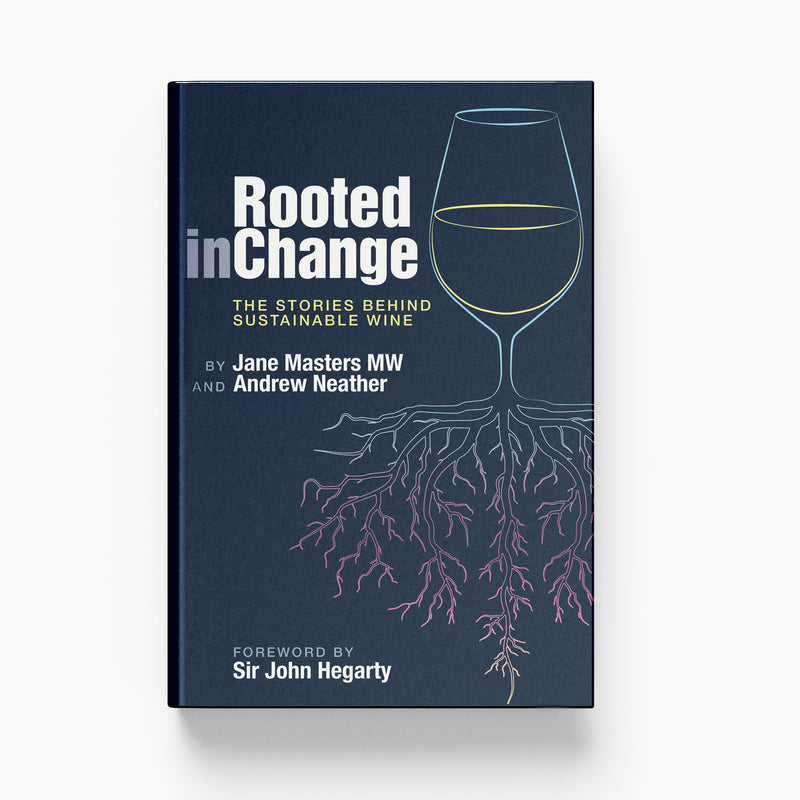
Andrew Neather, former wine critic for the Evening Standard and co-author of Rooted in Change: The Stories Behind Sustainable Wine, recently highlighted the risk of smoke taint, which can ‘damage wine quality, slash yields and even mean that whole vintages have to be written off’, he wrote on Substack. 

Smoke taint is very little understood. The danger is seasonal: studies have shown that grapes are worst affected if exposed between veraison (when grapes ripen, and the skins become softer and more permeable) and harvest, which is usually the period of peak wildfire danger. But beyond that, the exact conditions that worsen smoke taint remain a mystery. Neather notes that ‘wine from one patch can escape taint whereas a nearby parcel will be undrinkable’. Smoke taint is often only shown in grapes that have actually been exposed to smoke wafting through the vines, but there have also been reports from California and Australia of grapes being tainted despite being many kilometres from fires.

To make things even more difficult, the impact of smoke taint only becomes apparent after fermentation, when grape sugars have broken down. It is very tricky to test for smoke taint in the raw grape; it is certainly imperceptible to the tongue. This is because the compounds from the smoke (the two main culprits are guaiacol and 4-methylguaiacol) bind to natural sugars in the grape to form odourless sugar compounds, or glycosides. Affected wine takes on a foul ‘burnt’, ‘smoky’, ‘charry’ taste, often described as like a wet ashtray. Red wines tend to be worst affected due to the wine’s extended contact with skins (in which taint compounds are stored) during fermentation. 

Winemakers have experimented with treating tainted wines with a variety of methods, from activated carbon fining to reverse osmosis, but none have proved to be reliable. In fact, they can have a worse impact on the wine, stripping out desired aromas and messing with the wine’s molecular structure.  

Most producers are loath to admit that their harvest may have been affected by smoke taint. Despite the obvious risk to the Bordeaux harvest this year, local vineyard owners have played down the possibility of the vintage being ruined. A spokesperson for the CIVB, Bordeaux’s official wine body, said that across the Gironde’s wine growing regions, no impact on grape quality had been observed. 

The UK is not risk-free. In the first ten days of August alone, firefighters responded to 185 wildfires across England and Wales. A spokesperson for Domaine Evremond, the pioneering Kentish wine estate part-owned by Champagne Taittinger, reported that while the estate had suffered severe drought, it had not been under any immediate threat from wildfires. Precautionary measures had been taken in the form of a ban on outdoor cooking and smoking. There also weren’t any wildfires nearby, so smoke taint had not been a risk. The estate is aware of the threats of climate change, preparing vineyards to face wetter winters, but they are not currently planning to invest in fire-proofing. The risk is ‘unique to the past few weeks’ a spokesperson said, adding that the strategy ‘may change in the future’. 

Meanwhile in Warwickshire, one producer said that fire had been a ‘real concern’ for her vineyards. Adele Adams, the owner of Blabers Hall wine estate, explained that while the vines are able to cope with the heat, it was the growing conditions underneath that they had to be careful about. Because they don’t have an irrigation system, they’d stationed bowsers (towable tanks) full of water near the vines so that they could put out any sparks quickly. She’s not discounting investing in new technology to combat this threat in the future: ‘If next year has similar weather [...] I think if we see a growing trend then yes, it would be something that we have to look at - some form of irrigation, not necessarily for the vines themselves but for the ground underneath them.’ Luckily, she said that none of the fires in the West Midlands had been close enough for them to be ‘sufficiently worried’ about smoke taint. 

Stephen Skelton, the leading expert on British wine, said that he had only ever seen a few vineyards suffer fire damage - and then only singeing - the material found in vineyards not being the kind that burns very easily.

While UK vineyards may have so far escaped devastation, the question is whether producers will begin to seriously prepare for this threat that will only become more prominent in a future shaped by global heating. Skelton admitted that most growers want shelter around their vineyards to slow the wind down, and are not thinking about fire damage. ‘I don’t think people will start considering the problem until someone gets a burnt vineyard.’